

![[Power book cover]](https://richardheinberg.com/wp-content/uploads/2021/03/cover_POWERcatalog-proof_300x450.jpg)


 Originally published at The Guardian.
The tide of economic growth that has flowed since World War II may finally be ebbing.
For politicians and most economists, this is like saying the sky is falling. Growth has become guidepost and grail, the sine qua non of economic existence. Growth is necessary to job creation and the health of businesses. Without growth the rolls of the homeless and jobless swell, requiring governments to shoulder more responsibility; yet at the same time tax revenues fall, making both new and existing government debt unbearable.
Stimulating growth has become job number one for policy makers. David Cameron insists that his nation must deregulate business and reform employment law in order to “go for growth.” And at the conclusion of the recent G20 global economic summit, President Obama reported that the discussions there had revolved around the question, “How do we achieve greater global growth?” Such statements raise nary an eyebrow; they are entirely expected.
Nonetheless, in recent years a few economists have advanced a contrary view. Tim Jackson in the UK, Herman Daly in the US, and Serge Latouche in France have argued that growth is not always good for the environment or for the real health of communities, and that GDP growth is impossible to sustain over the long run anyway because we live on a planet with limited natural resources. Their position has won few adherents in the mainstream. In the “real” worlds of politics and economics, questioning growth is like arguing against gasoline at a Formula One race.
But doubts about growth are no longer theoretical. We seem to have arrived at a moment when further economic expansion is hemmed in by financial as well as natural limits. As extraction industries chewed through the low-hanging fruit of the world’s oil, coal, natural gas, and other minerals, and turned to lower-grade and thus more expensive ores and fuels, managers of the economy tried to keep growth going by piling up debt in the mistaken belief that it is only money that makes the economy run, not energy and raw materials. Today, high oil prices are keeping a lid on commercial expansion in the older industrial nations as petroleum demand shifts to the hyperactive economies of Asia, which for now can afford steeper fuel prices. Meanwhile we in the West seem to have maxed out government and consumer credit, and that realization is sending financial markets into fibrillation. With energy resources and credit both stretched tight, that means more economic growth may simply not be possible in the US and Europe, regardless of our opinions about it.
If policy makers fail to recognize this and continue assuming that the current debt crisis is just another turning of the business cycle, then we may lose whatever opportunity still remains to avert a crash that could bring civilization to its knees. Over the short run, this is scary business. Financial markets have a hair trigger, and fears about flagging growth could bring down governments and banks.
Still, over the longer term there will undoubtedly be life after growth, and it doesn’t have to play out under miserable conditions. With less energy to fuel globalization and mechanization there should be increasing requirement for local production and manual labor. We could meet everyone’s basic needs by prioritizing jobs in manufacturing and agriculture while downsizing the financial industry and the military. We will also have to reduce economic inequality and corruption (as the rapidly spreading Occupy movement rightly insists). As we do these things, we must reform economics to reflect ecological reality: nature is not, after all, just a pile of raw materials waiting to be transformed into products and then waste; rather, ecosystem integrity is a precondition for society’s survival. Adaptive responses cannot only be left up to government officials and economists; for their part, households must rein in debt and over-consumption while contributing more to community resilience.
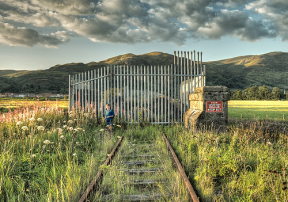
There’s light at the end of the tunnel. If we focus on improving quality of life rather than boosting quantity of consumption, we could be happier even as our economy downsizes to fit nature’s limits.
But a benign future is unlikely to transpire if we all continue living in a dream world where growth knows no bounds, where debt can be repaid with more debt, and where natural resources are assumed to be endless.
Alarm bells are ringing. Wake up to the post-growth economy.
Image credit: delphwynd/flickr